
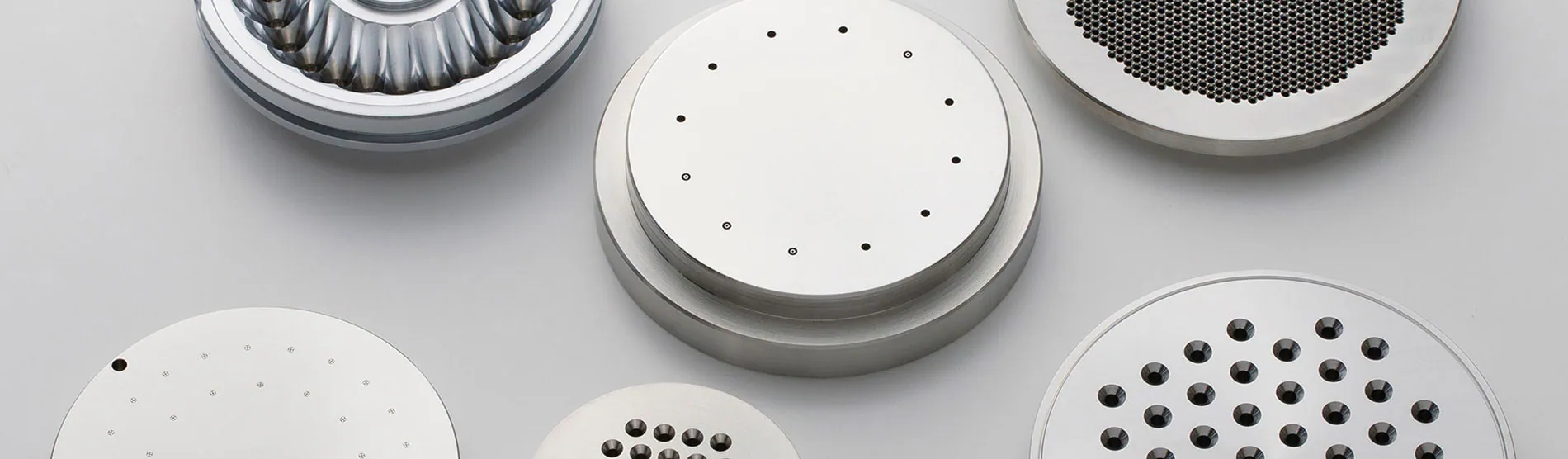
Product details
Spinneret specification
Accuracy, capillary tolerances, profiled holes, materials and cleaning of the spinnerets we make.
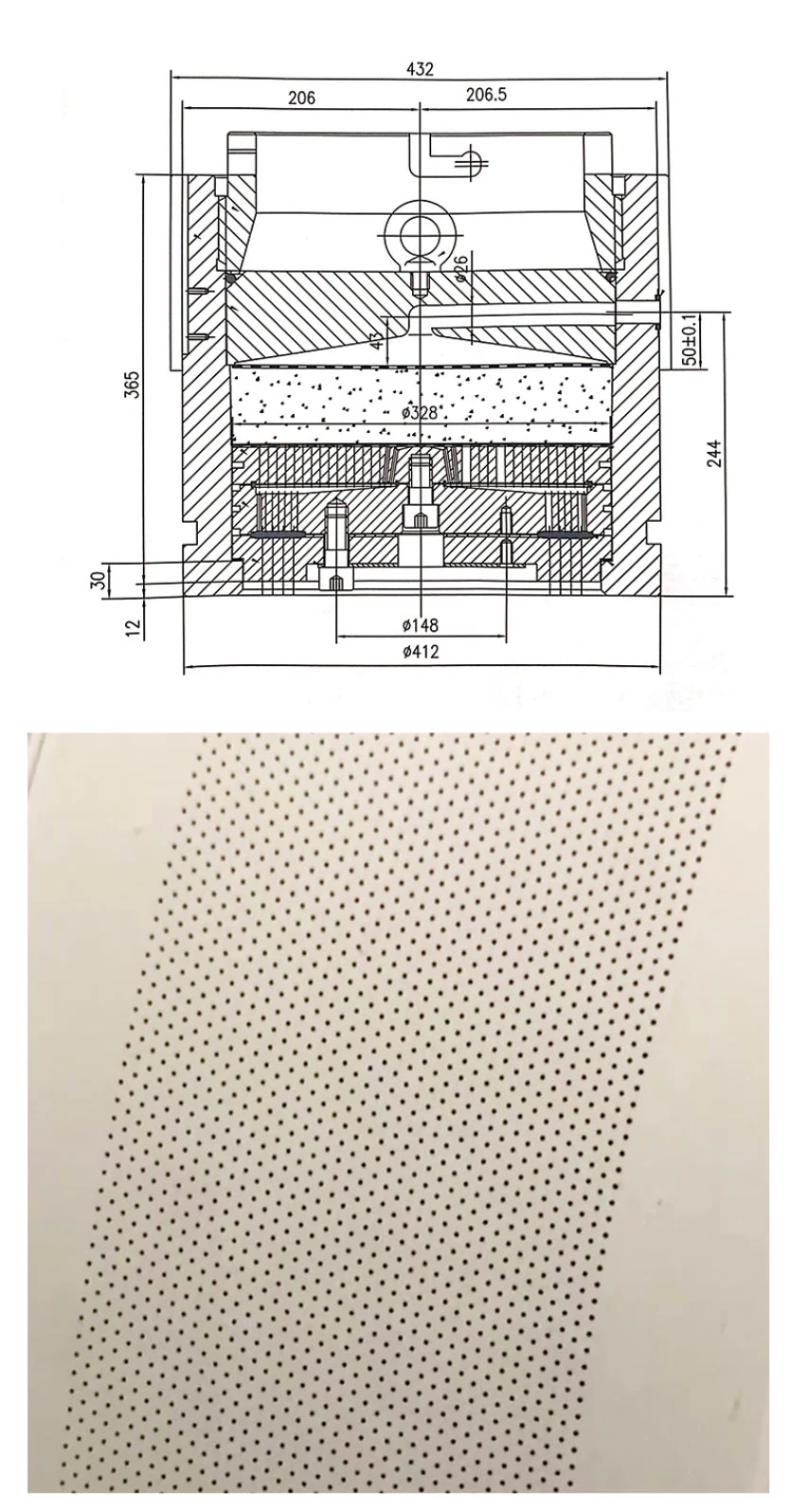
Our spinnerets are made with capillaries from Ø0.04 to Ø1.00 mm, held to ±0.001–0.002 mm in the special grade. Hole walls are finished to N1–N7 depending on the section, and the exit side is mirror-buffed to N1 or lapped to a mat N2–N4 finish.
Accuracy of spinneret
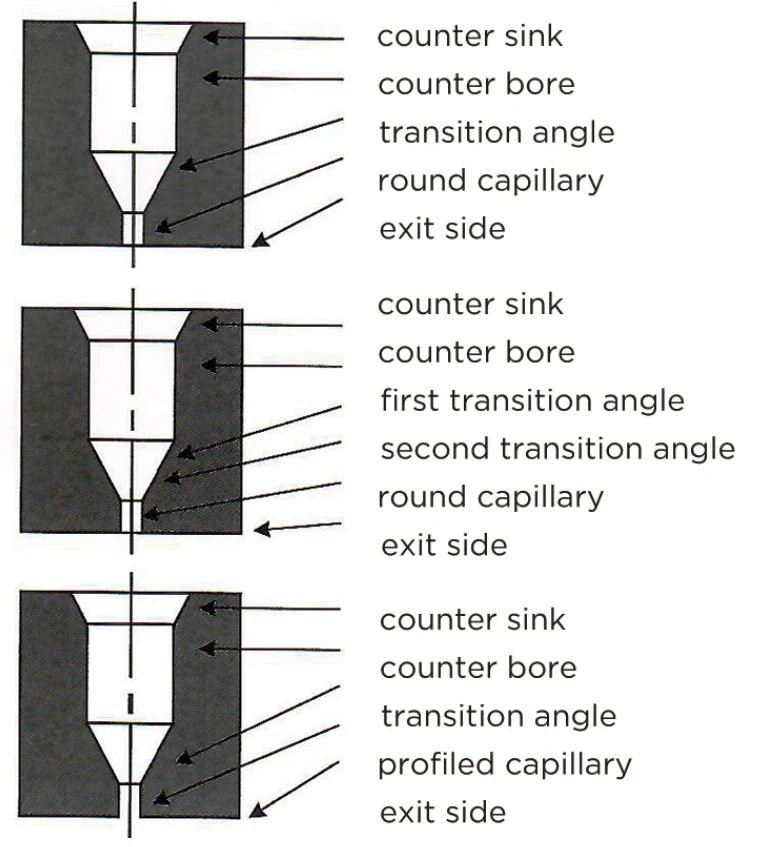
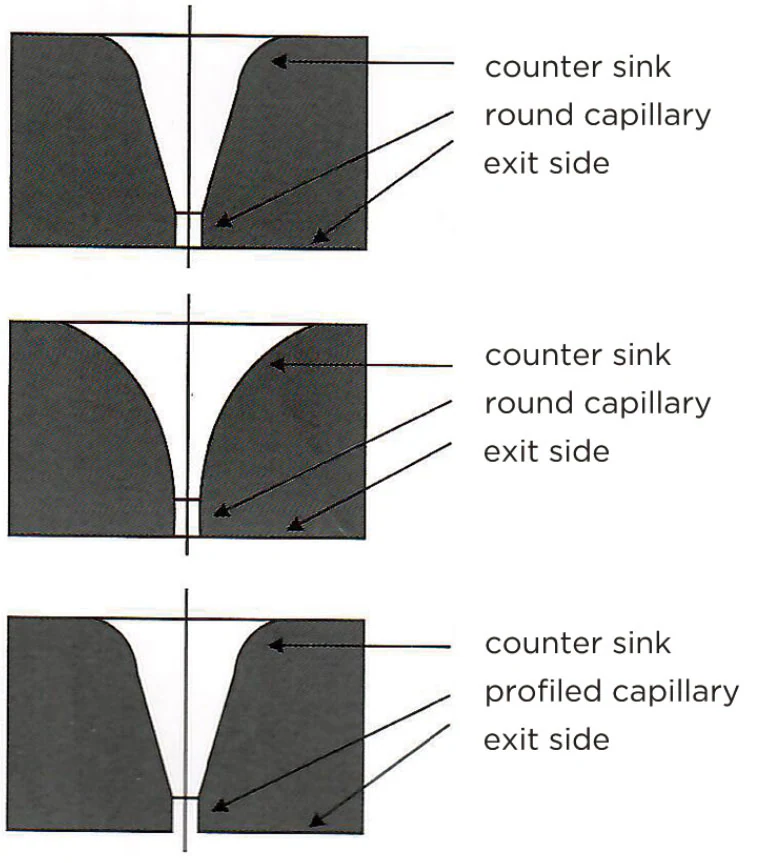
Surface roughness of spinneret hole (ISO)
| Countersink | N5 – N7 |
| Counterbore | N3 – N6 |
| Transition angle | N2 – N6 |
| Capillary | N1 – N6 |
Surface roughness of exit side (ISO)
| Mirror finish by buffing | N1 |
| Mat finish by lapping | N2 – N4 |
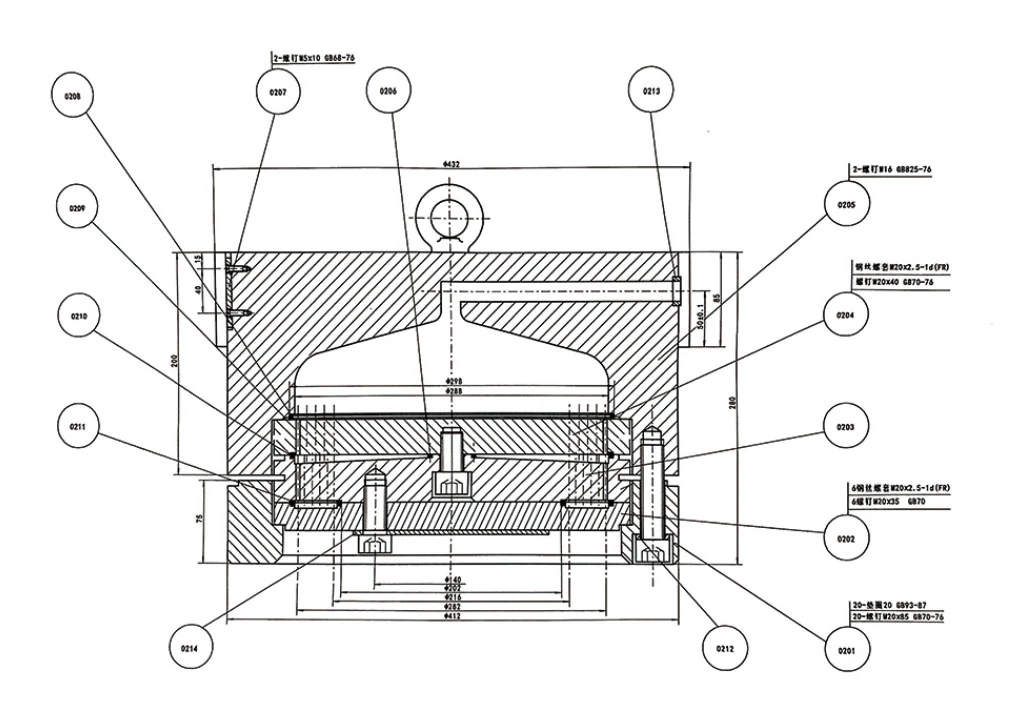
Tolerance of capillary
All dimensions in mm.
Round hole spinneret
| Diameter of capillary D | Length of capillary L | Tolerance of D | Tolerance of L | ||
|---|---|---|---|---|---|
| Special | Precision | Special | Precision | ||
| Ø0.04 – Ø0.10 | ≤1.00 | ±0.001 | ±0.002 | ±0.01 | ±0.02 |
| Ø0.11 – Ø0.20 | ≤3.00 | ±0.002 | ±0.002 | ±0.01 | ±0.02 |
| Ø0.21 – Ø0.50 | ≤5.00 | ±0.001 | ±0.002 | ±0.01 | ±0.02 |
| Ø0.51 – Ø1.00 | ≤8.00 | ±0.002 | ±0.004 | ±0.02 | ±0.04 |
Profiled hole spinneret
| Width of slit W | Length of capillary L | Tolerance of W | Tolerance of l, r, d, g, a | Tolerance of L | |||
|---|---|---|---|---|---|---|---|
| Special | Precision | Special | Precision | Special | Precision | ||
| 0.04 – 0.06 | ≤5.0W | ±0.002 | ±0.003 | ±0.015 | ±0.025 | ±0.02 | ±0.03 |
| 0.06 – 0.10 | ≤10.0W | ±0.002 | ±0.003 | ±0.015 | ±0.025 | ±0.02 | ±0.03 |
| 0.10 – 0.20 | ≤20.0W | ±0.002 | ±0.003 | ±0.015 | ±0.025 | ±0.02 | ±0.03 |
| ≥0.20 | ≤30.0W | ±0.002 | ±0.003 | ±0.015 | ±0.025 | ±0.02 | ±0.03 |

Profiled holes
Shapes of spinneret holes we machine — trilobal, cross, hollow segments, star and more.

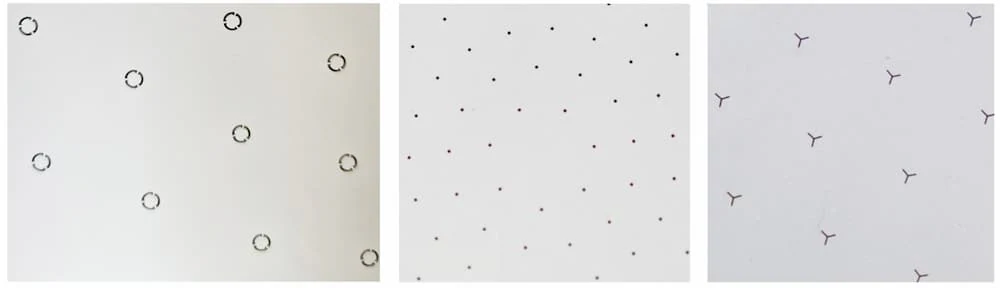
Shapes of spinneret hole and materials
Spinneret steels
| Type | AISI 304 | AISI 316 | AISI 316L | AISI 317L | AISI 321 | AISI 431 | AISI 630 |
|---|---|---|---|---|---|---|---|
| DIN | 1.4301 | 1.4401 | 1.4404 | 1.4438 | 1.4541 | 1.4057 | 1.4542 |
| JIS | SUS304 | SUS316 | SUS316L | SUS317L | SUS321 | SUS431 | SUS630 |
| GB | 0Cr18Ni9 | — | 0Cr17Ni14Mo2 | — | 1Cr18Ni9Ti | 1Cr17Ni2 | 0Cr17Ni4Cu4Nb |
| C ≤, % | 0.08 | 0.08 | 0.03 | 0.03 | 0.12 | 0.17 | 0.07 |
| Cr, % | 18–20 | 16–18 | 16–18 | 18–20 | 17–19 | 15–17 | 15.5–17.5 |
| Ni, % | 8–10.5 | 10–14 | 10–14 | 11–15 | 8–11 | 1.5–2.5 | 3–5 |
| Mo, % | — | 2–3 | 2–3 | 3–4 | — | — | — |
| Cu, % | — | — | — | — | — | — | 3.5 |
| Ti, % | — | — | — | — | 5×C – 0.8 | — | — |
| Nb/Ta, % | — | — | — | — | — | — | 0.15–0.45 |
| Density, 1000 kg/m³ | 7.9 | 7.95 | 7.95 | 7.95 | 7.9 | 7.7 | 7.75 |
| Yield strength (0.2% offset), MPa ≥ | 196 | 205 | 176 | 176 | 205 | 588 | 785 |
| Tensile strength, MPa | 496–600 | 496–600 | 480–600 | 480–600 | 496–600 | 785–1370 | 840–1370 |
| Elongation, % ≥ | 50 | 45 | 50 | 50 | 50 | 14 | 14–22 |
| Reduction of area, % | 60 | 60 | 60 | 60 | 60 | 45 | 52–56 |
| Hardness (solution annealed), HB | 130–180 | 130–180 | 130–180 | 130–180 | 130–180 | 250–270 | 270–290 |
| Elastic modulus, GPa | 197 | 197 | 197 | 197 | 197 | 204 | — |
| Magnetic | No | No | No | No | — | Yes | Yes |
| Hardness range for spinnerets | HB 130–180 | HB 130–180 | HB 130–180 | HB 130–180 | HB 130–180 | HRC 26–35 | HRC 28–44 |
Hardness was determined upon the heat treatment processes (as) H900, H1025, H1075, H1150: HRC <40, ≥35, ≥31, ≥28.
Tantalum for wet spinning
| Density, g/cm³ | Tensile strength, MPa | Elongation, % | Hardness HV0.2 | Hardness after treatment HV0.05 |
|---|---|---|---|---|
| 16.6 | 313.6 | 25 | 90–120 | 300–500 |
Cleaning of the spinnerets for melt spinning
To clean spinnerets, you may choose one of the following methods which we recommend.
Spinneret cleaning equipmentCalcination
In an automatic box-type furnace, the spinnerets are heated to 450–480 °C. When the temperature exceeds 480 °C, superheated steam passes through the calciner to blow out the flames and lower the temperature, so that the spinnerets can be protected from damage.
Salt Bath
Formed by a NaNO3 (45%) – NaOH (10%) mixture (melting point 200 °C), the salt bath acts as a strong oxidant at its operating temperature of 450–500 °C. The polymer is decomposed to CO2 and H2O very quickly in 60 to 90 minutes. After processing, any remaining salts on the spinnerets should be washed away with hot water, oxides removed by dilute nitric acid, and then washed sequentially in clean water, an ultrasonic tank, and finally dried.
Procedyne Fluid Bed
At a temperature of 450–500 °C, aluminum oxide powder is fluidized by a hot air stream and scours the spinnerets. About 70% of the polymers are detached and decomposed. A small amount of carbon becomes CO. All these, including inorganic substances such as TiO2, are discharged in the air. The advantage of this method is that the spinnerets can be cleaned automatically.
TEG Method
First, place the spinnerets in a boiling solution containing NaOH (15%–20%) for 2 to 3 hours to remove most of the polymer, then place them in a TEG bath at 260–280 °C for about 12 hours. After cooling, the spinnerets should still be washed sequentially in alkaline solution, clean water, and an ultrasonic tank before drying and storage. The process should avoid overheating and is suitable for any type of stainless-steel spinnerets, but it takes a rather long time.
Vacuum Calciner
By burning in low pressure and vacuum, most of the polymer can be decomposed. The remaining residue is washed out in the same furnace. The whole process can be automatically controlled and is easy to operate.
Questions
What capillary tolerance can a spinneret be made to?
For round-hole spinnerets with capillaries of Ø0.04–1.00 mm, the tolerance of the capillary diameter is ±0.001 to ±0.002 mm in the special grade and ±0.002 to ±0.004 mm in the precision grade. Profiled slits of 0.04 mm and wider are held to ±0.002 mm (special) or ±0.003 mm (precision).
Which steels are used for spinnerets?
Austenitic stainless steels 304, 316, 316L, 317L and 321 (hardness HB 130–180), and the hardenable grades 431 (HRC 26–35) and 630 (HRC 28–44). Tantalum is used for wet-spinning spinnerets.
How are melt-spinning spinnerets cleaned?
Recommended methods are calcination at 450–480 °C, a NaNO3–NaOH salt bath at 450–500 °C, a Procedyne fluid bed, the TEG method (NaOH boil, then TEG at 260–280 °C) and a vacuum calciner.
Need a spinneret to these tolerances?
Send your drawing or hole specification.